The Insurrection of the Resurrection
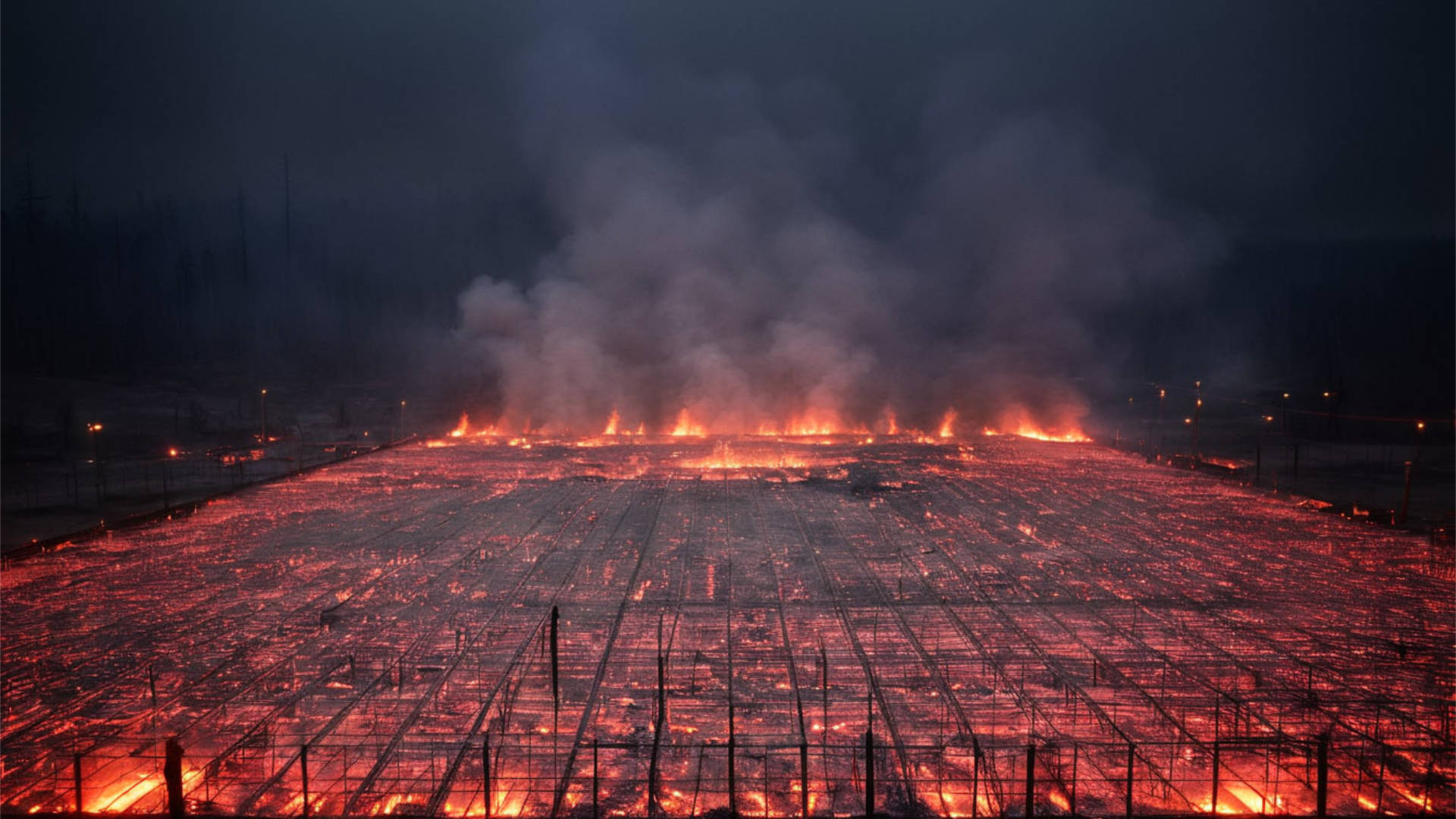
The trial for pessimism transforms ecological consciousness into psychological pathology rather than ontological access. When one attempts to confront the irremediable—extinction without-remainder, the closure of all future testimony—this confrontation is often reframed as personal despair. This psychologization participates in the repression of destruction phenomena: artworks engaged with extinction are not envisaged as such but rejected as expressions of sick minds. This denial of destruction finds an accomplished political formulation in vectorfascism. Yet Pierre Huyghe’s Liminal (2024, Punta della Dogana) stages this extinction ontologically rather than psychologically by representing disappearance through three interconnected phases. The work begins with de-subjectivation: hollow human forms without faces wander an impossible lunar landscape, stripped of reflexivity and reduced to pure sensory reactivity, the condition of the species facing its own obsolescence. This transforms into extinction as geological temporality, where machines film a skeleton in a desert like landscape returned to Earth, our civilization becoming strata awaiting discovery by unknown future entities. Finally, imagination emerges from accumulated data: a machine generates new forms of quasi-biological organisms, post-extinction creation that endures beyond the human. Liminal is not pessimistic but radically realistic, it stages species finitude not as psychological disturbance but as ontological truth.
The term vectofascism designates the contemporary political formation characterized by the vectorization of collective affects through the vectorial paradigm of the latent space of ‘AI’ and the promise of a technological overcoming of all contradictions. Vectofascism is distinguished from historical fascism by its specific relation to temporality: where classical fascism promised a thousand-year Reich, vectofascism promises technological immortality; where the former organized total mobilization of bodies, the latter organizes total mobilization of data. But in both cases, the logic remains identical: to conjure finitude through power, to resolve the anxiety of death through the intensification of domination. Vectofascism wants to continue at all costs—“drill, baby drill”—precisely because it is incapable of confronting finitude. And this is precisely what the trial for pessimism of art does: it refuses to confront what, in the work, exceeds psychology to reach ontology, that is, the question of being as being-toward-the-end.
Our finitude is that of the species and it then becomes something that is common to us in an unprecedented way. It has this specificity that it signs the probable cessation of transmission, of the transfer of knowledge from one body to another body. In other words: species finitude is the death of each representative of our species, until the last witness. No more possible transmission, no more inheritance, no more collective memory, only the pure and simple interruption of the anthropological chain that linked the dead to the living and the living to the not-yet-born. This perspective might seem dreadful, but the truth is that it is no less so than individual finitude. On the contrary, the consciousness of individual finitude can open to an expansion of what we will call existential agentivity: the capacity of a finite being to act in full consciousness of its finitude, not despite it but thanks to it.
Taking species finitude into account from the perspective of individual finitude could provoke a more intense sense of passibilité in the manner of a wound. This term designates the fundamental state of exposure to affects prior to any symbolic representation. In Lyotard, passibilité is intimately linked to childhood—a state where the subject remains entirely receptive to sensations without possessing the linguistic codes to master or represent them. The child undergoes affect in its raw immediacy, before language comes to mediate this exposure. This radical passibilité reveals a fundamental différend: there always exists an irreducible gap between what is felt (the affect) and what can be said of it. Passibilité is therefore not simple receptivity, it is the condition of being-unable-to-represent what affects us. This passibilité in no way consists in seeking a cure, because it knows how to recognize that the living that we are, are just as well dead, and that all our productions aim at this death, not as a sacrifice but as factuality itself insofar as death is certain and uncertain.
We know that we are going to die (absolute certainty) but we generally know neither the moment nor the conditions of this event (radical uncertainty). This aporia of one’s own death is multiplied at the scale of the species: we know that the human species will eventually disappear, but we know neither when nor how, and we do not know either who will be the last witness of this disappearance. This consciousness of species finitude is fundamental because it constitutes the only conceivable common, not to produce a people subjected to destiny, but becoming an insurrection of the resurrection in an ambiguous and highly undecidable posture. The violent rejection of the finitude of the species extends beyond billionaires to social and media figures. Climate activists face death wishes from commentators precisely because reminding others of finitude as a general condition, our common mortality, but also entropy, represents an attack on illusions of transcendence. The finitude of the species threatens the fantasy of unlimited consumption, infinite growth, technological or theological salvation. Ordinary citizens who have invested in these fantasies perceive awareness of finitude as a threat, hence the visceral rejection that reveals how vector fascism’s denial of finitude operates psychologically: it promises transcendence of death itself, making those who insist on our common mortality appear not as spokespeople for truth, but as enemies of hope. Recognizing this dynamic explains why ecological awareness provokes such vehement resistance.
The insurrection of the resurrection designates the movement by which a collectivity rises up against its own finitude not to deny it but to fully assume it, thus transforming the consciousness of collective death into a power of affirmation. It is at the heart of extinction that the human species reveals itself in its unity, because the end of all is the end of each. This revelation of the unity of the species in the imminence of its disappearance constitutes what we could call a communism of extinction: we will never have been individually anything but the desire for a survival of the dead in those who are not yet born. This is why Liminal by Pierre Huyghe, which explicitly represents disappearance, is in no way pessimistic but realistic in the strongest sense of the term. It is not merely this or that factual condition to which one could find a punctual remedy; it is the very nature of a species to appear and disappear.
Scalar Dis-orientation
Faced with the hegemony of the vectorial paradigm that traverses the entire contemporary political spectrum, it appears necessary to elaborate responses that do not simply reproduce new forms of vectorization under other modalities. Three alternative paths emerge.
The first path consists in a radical deconstruction of identity as the foundation of social organization. This approach does not consist in substituting new identity categories for old ones, but in questioning the very principle of stable and univocal identity that underlies all vectorization. Identity is no longer conceived as an essence constituted of attributes susceptible to being assigned to vectors, but as a dynamic and relational process irreducible to any definitive categorization. This deconstruction operates simultaneously at theoretical and practical levels. At the theoretical level, it implies a systematic critique of the essentialist presuppositions that underlie vectorial assignments. At the practical level, it translates into the elaboration of social and institutional devices that refuse to found their functioning on prior identity assignments.
The second path consists in the elaboration of a logos structurally troubled by doubt—that is, of an alternative rationality that integrates doubt not as a provisional insufficiency to be overcome, but as a constitutive and productive dimension of thought. This alternative logos recognizes its own situated and partial character and integrates this recognition as the very condition of its validity. The integration of doubt into the logos implies a profound transformation of our relation to social knowledge. Where the vectorial paradigm aims to eliminate uncertainty through definitive categorial assignments, the logos of doubt keeps open the possibility of a fundamental inadequation between categories and the realities they claim to grasp.
The third path would reside in systematic incorporation of feedback loops into modes of conceptualizing the social. Yet transformer architecture in contemporary AI reveals the limits of this strategy. Unlike linear vectorial logic proceeding unidirectionally from assigner to assigned, transformers operate through attention mechanisms that create multidirectional, recursive relationships between vector positions. Each element affects every other element through iterative layers, producing what appears as democratic circulation but functions as intensified capture. Transformers work by computing attention weights across all positions in a sequence simultaneously, no single direction governs the process. This non-directional feedback appears liberatory: assigned entities could seemingly contest assignments through recursive re-evaluation. But this multidirectional feedback actually amplifies affective modulation. Because vectors continuously recalibrate in relation to all other vectors without ever stabilizing, no fixed position from which to launch contestation emerges. Feedback becomes infinite circulation without exit. At the epistemological level, this architecture makes it impossible to distinguish original signal from transformed signal, knowledge and its effects become indistinguishable. At the social level, institutional devices ostensibly allowing contestation become feedback mechanisms that continuously re-integrate resistance into the system itself. Critique circulates endlessly without ever accumulating force for transformation. The transformer’s non-directional architecture doesn’t enable resistance; it ensures that resistance itself becomes data for further optimization.
This triple orientation—deconstruction of identity, logos of doubt, incorporation of feedback loops—sketches the contours of a politics of scalar dis-orientation that would preserve the intensity of differences (their scalar character) while renouncing imposing on them a predetermined vectorial orientation. Such a politics would not aim at the illusory elimination of all social differentiation, but at the institution of a non-vectorial regime of differentiation, founded on the recognition of irreducible singularities. This alternative politics does not constitute an abstract utopia, but a concrete orientation capable of informing institutional, social, and technological practices in multiple domains. Its fundamental stake is the elaboration of modes of thought and social organization that preserve the irreducible singularity of individual existences while making possible a collective intelligibility of the social. Faced with this systemic threat, resistance can no longer content itself with criticizing Western cultural imperialism, but must defend spaces of transnational circulation and exchange against their authoritarian closure. The contemporary challenge is no longer to fight against cultural globalization, but to preserve its potentialities of radical equality against their recuperation by policies of national alignment.
The irony is striking: at the moment when critics of cultural globalization were calling for more diversity and horizontality in international exchanges, alignment produces a system infinitely more repressive than the old Western hegemony. Where neoliberal globalization left interstices, margins, possibilities of diversion, territorial alignment produces hermetically closed cultural spaces, optimized according to national objective functions. This globalization of alignment constitutes a new type of hegemony: no longer that of a dominant cultural model, but that of a universalizable technology of domination that is declined in national versions. Repressive innovations circulate freely between regimes while artists and works see their circulation hindered by increasingly watertight cultural borders. The development of an alternative perhaps constitutes the fundamental political and intellectual task of our time. This task does not consist in substituting new vectors for old ones, but in elaborating modes of thought and social organization that escape the very logic of vectorization. It is in this gap, in this fundamental dis-orientation, that perhaps resides the possibility of emancipatory politics for our present.
At the moment when the finitude of one alone will be that of all, then perhaps we will finally be human. This proposition suggests that humanity does not yet exist as an accomplished reality but as a possibility to come, and that this possibility will perhaps actualize itself only at the extreme limit of its disappearance. Humanity as a biological species has existed for millennia, but humanity as a community conscious of its common finitude remains largely to be invented. This invention of the human through consciousness of its common finitude constitutes the major political stake of our era. It implies an overcoming of the individualism that has characterized Western modernity, not in favor of a collectivism that would dissolve singularities, but in favor of a plural singularity where each individual existence would take meaning only through its participation in a common destiny.
Contemporary art that confronts extinction therefore does not engage in psychological pessimism but in ontological realism. It helps us think what it means to exist as a mortal species in an indifferent universe, and it helps us imagine what an authentic human existence could be once the illusions of technological immortality and absolute mastery of nature are abandoned. This education in finitude does not aim to make us resign ourselves to our fate but to free us from fantasies of omnipotence that prevent us from fully inhabiting our mortal condition. It teaches us that consciousness of the end, far from paralyzing action, can on the contrary give it a new intensity and urgency. For if everything must end, then each moment counts; if the species itself is mortal, then each human gesture takes on inestimable value; if transmission is not guaranteed, then creation becomes an act of absolute resistance against universal entropy. It is in this tension between the recognition of our common finitude and the exploration of possibles that open up in the latent space of our existence that the future of our capacity to become other than ourselves is at stake. For it is paradoxically in the ruins of the old cultural globalization, despite its inequalities and limits, where the possibilities of experimentation, contestation, and struggles reside. The work of art that confronts extinction does not console us for our finitude, it awakens us to it—and it is in this awakening that perhaps resides our last chance to invent a political common that is not one of submission, but one of the insurrection of the resurrection.
The Latent Space as Political Battlefield
The concept of vectofascism reveals how contemporary forms of domination operate in dimensions that escape direct perception and traditional modes of resistance. By transposing the logic of machine learning alignment to cultural and political institutions, vectofascism institutes a regime of power that no longer needs to openly repress but can modulate behaviors, affects, and beliefs through the subtle manipulation of informational environments. This transformation poses unprecedented challenges for emancipatory politics. How to resist a form of power that operates in latent spaces inaccessible to direct representation? How to organize collective action when algorithmic systems systematically produce epistemic bubbles that prevent the emergence of a common understanding of reality? The analysis of vectofascism suggests that effective resistance must operate on multiple fronts simultaneously:
At the epistemological level, it requires developing critical literacies capable of making visible the invisible mechanisms of algorithmic modulation. This does not mean simply denouncing ‘fake news’ or ‘filter bubbles,’ but understanding in depth how vector spaces structure perception and cognition in the digital age.
At the technical level, it necessitates creating alternative infrastructures that do not reproduce the extractive logic of surveillance capitalism. This includes developing AI systems designed not to maximize engagement but to facilitate genuine dialogue across differences, protocols that preserve privacy while enabling collective action, and platforms that resist the logic of optimization toward predetermined objectives.
At the aesthetic level, it demands exploring the potentialities of generative technologies not to produce endless variations of the already-known, but to make visible what the dominant regime renders invisible. This ‘factitious aesthetics’ affirms the simulacrum as simulacrum, creating a reflexive distance that opens space for critical thought.
At the political level, it requires building coalitions capable of transcending the epistemic divisions systematically produced by algorithmic systems. This is perhaps the most difficult challenge: how to create solidarity between people who no longer inhabit the same informational universe, who no longer share the same criteria of truth, who no longer speak the same political language?
The concept of ‘scalar dis-orientation’ proposed in this text offers a promising direction. Rather than trying to impose new vectorial orientations—which would simply reproduce the logic of vectofascism under another banner—it suggests preserving the intensity of differences while renouncing assigning them predetermined directions. This is a politics of singularity that refuses reduction to identity, a politics of the common that does not presuppose homogeneity. The worldwide spread of alignment technologies reveals that we are not facing isolated national phenomena but a global reconfiguration of the relationship between power and culture. From Budapest to Beijing, from Washington to Moscow, the same techniques of cultural optimization circulate and adapt to local contexts. This globalization of alignment produces a paradox: while nationalist rhetoric emphasizes borders, cultural sovereignty, and the defense of specific identities, the technologies of domination themselves circulate without hindrance. What is universalized is not a particular cultural model but a technology of control applicable to any cultural content. This situation overturns traditional critical frameworks. The old opposition between cultural imperialism and national resistance becomes obsolete when each nation develops its own version of algorithmic authoritarianism. Within this context, the critique of Western cultural hegemony, legitimate in its time, risks becoming an instrument of legitimization for even more repressive forms of domination.
Resistance must therefore be rethought. It is no longer a matter of defending national cultures against globalization, but of defending the transnational spaces of circulation and exchange that make possible encounters, hybridizations, and transformations. These spaces—international art scenes, academic networks, digital platforms not entirely captured by surveillance logic—constitute the fragile terrain where alternatives can still be imagined. The irony is that these spaces, imperfect products of neoliberal globalization with all its inequalities, now appear as zones of relative freedom compared to the hermetically aligned national spaces that replace them. It is not about idealizing neoliberal globalization, but about recognizing that the nationalist reaction produces something infinitely worse: a world fragmented into cultural fortresses, each optimized according to its own authoritarian logic.
The final sections of this text return to a dimension that might seem tangential to the analysis of vectofascism but reveals itself to be fundamental: the question of species finitude and its political implications. This is not a simple ecological or philosophical digression, but the identification of what could constitute a truly universal common beyond vectorial divisions. Vectofascism, with its promise of technological immortality and unlimited growth (“drill, baby drill”), is revealed as a massive denial of finitude. Its ideology of optimization without limit, of perpetual improvement, of overcoming all constraints through technology, expresses a fundamental incapacity to confront mortality—individual and collective. Against this denial, the consciousness of species finitude opens a radically different political perspective. If we are all destined to disappear, not only as individuals but potentially as a species, then the vectorial divisions that structure contemporary politics lose their absoluteness. The ultimate horizon of extinction reveals a common condition that no identity assignment can erase. This is not about falling into a morbid fatalism or an apocalyptic nihilism. On the contrary, consciousness of species finitude can function as the foundation of an ‘existential agentivity’ intensified by the very precariousness of our condition. When transmission is not guaranteed, each gesture of creation becomes an act of resistance against entropy. When the species itself is mortal, solidarity between its members takes on an existential urgency that transcends all particular divisions.
The analysis developed throughout this text leads to a fundamental question: what form can emancipatory politics take in an era when power operates in latent spaces inaccessible to direct representation, when truth itself is dissolved in probabilistic distributions, when collective action is systematically undermined by the algorithmic production of epistemic divisions? Traditional responses—consciousness-raising, organization, confrontation with power—remain necessary but insufficient. They presuppose a shared reality that algorithmic systems precisely work to fragment. How to raise consciousness when there is no longer a common world to become conscious of? How to organize when potential allies are enclosed in impermeable informational bubbles? How to confront power when it denies its own existence?
The proposition of ‘scalar dis-orientation’ offers a possible path, but one that remains largely to be explored. It suggests that resistance to vectofascism cannot take the form of an alternative vectorization—the designation of new enemies, the mobilization around new identities, the imposition of new directions. All these strategies would reproduce the fundamental logic they claim to oppose. Instead, it is necessary to imagine a politics capable of preserving the intensity of differences (their scalar character) while refusing to assign them predetermined directions. This requires institutional, social, and technical devices that:
- Fixed Identity Refusal
Refuse to found social organization on fixed identity assignments, recognizing instead that identities are fluid, multiple, contradictory processes irreducible to stable categories.
#identity - Accepting Doubt
Integrate doubt and uncertainty not as provisional deficiencies but as constitutive dimensions of collective deliberation, developing forms of rationality that accept their own limits and partiality.
#doubt - Re-categorization
Institute feedback loops that allow subjects to contest and transform the categories applied to them, making the social world perpetually revisable rather than definitively categorized.#feedback, #category
These principles may seem abstract, but they translate into concrete practices: participatory governance systems that give voice to those usually excluded, protocols for intercommunity dialogue that do not presuppose prior agreement on fundamentals, technologies designed to facilitate understanding across differences rather than maximize engagement within echo chambers. Certainly, the left has attempted various forms of political commoning for decades. But these attempts have been systematically captured by the representative-delegative framework: base assemblies, workers’ councils, participatory democracy. Each time, deliberations were reintegrated as optimization variables within the existing system. The Taiwanese example of vTaiwan illustrates this perfectly. A deliberation platform launched after the Sunflower Movement (2014) and integrated into government by digital minister Audrey Tang, vTaiwan seemed to transcend representation through bottom-up consensus using the Polis principle. But the government progressively limited vTaiwan to digital questions alone (online drag regulation, laws against non-consensual intimate images). When the government created a parallel platform called Join for other issues, this rendered vTaiwan redundant. Described as “a tiger without teeth,” vTaiwan never revolutionized the political system—only captured and channeled citizen speech toward pre-existing governmental conduits. Commoning must operate differently: not as deliberation for being represented, but as absolute refusal of decision capture itself. Not participating in the system, but withdrawing from its logic of vectorial mediation altogether. The difficulty is that these practices must be developed within a context where the forces of vectofascism are powerful, well-funded, and supported by some of the most sophisticated technologies ever created. Resistance cannot rely on moral superiority or the presumed justice of its cause. It must develop its own technical, organizational, and aesthetic capacities. This is perhaps where consciousness of species finitude reveals its political productivity. In the face of the ultimate horizon of collective disappearance, vectorial divisions lose their naturalized character. They appear as what they are: historical constructions, modifiable arrangements, choices rather than necessities.
This consciousness does not automatically produce solidarity—history shows abundantly that awareness of common danger can just as easily produce every-person-for-themselves and murderous competition. But it opens a possibility: that of recognizing in the other, beyond all differences vectorially assigned, a fellow mortal, someone who shares the same fundamental precariousness. This recognition is the opposite of the false universalism that capitalism mobilizes. It is not about denying differences or pretending they don’t matter. It is about situating differences within a horizon that relativizes them without erasing them—the horizon of our common finitude.
Throughout this analysis, art appears not as a marginal domain but as a privileged site where the contradictions of our era can be thought and felt. Whether it is Beeple’s work revealing the complicity between kitsch aesthetics and vectofascist politics, or Pierre Huyghe’s Liminal confronting species extinction, or experimental uses of generative AI exploring the limits of latent spaces, art plays an irreplaceable epistemological role. This is because art can operate simultaneously in multiple registers that remain separated in discursive thought. It can think through the senses, make visible the invisible, create experiences that escape algorithmic categorization. In an era when power operates increasingly in latent spaces inaccessible to direct representation, this capacity of art to produce intuitions and affects becomes politically crucial. But the text also warns against facile interpretations. Not all art that uses generative technologies is critical, and the boundary between ‘factual aesthetics’ (which encloses us in the nauseating repetition of the already-known) and ‘factitious aesthetics’ (which explores genuinely new possibles) is often undecidable. The case of the Gaza video, conceived as critical satire but reappropriated by Trump, perfectly illustrates this reversibility. This undecidability is not a defect but a characteristic of art in the age of vectofascism. In a regime where every social utterance is turned into content and all content can be instantly reappropriated, detoured, or inverted; the stability of meaning becomes impossible. This creates particular responsibilities for artists and intellectuals: they cannot rely on the presumed evidence of their critical intentions but must constantly work to create contexts that resist reappropriation.
Critical thought faces similar challenges. Traditional critical methods—ideology critique, discourse analysis, material examination of power relations—remain indispensable but must be supplemented by new capacities: understanding the mathematics of latent spaces, analyzing algorithmic systems, thinking the temporality of generative processes, imagining alternatives that do not simply reproduce what they oppose. This requires unprecedented forms of interdisciplinary collaboration. Philosophers must work with computer scientists, artists with mathematicians, activists with engineers. Not in a naive spirit of disciplinary fusion, but with the recognition that the problems we face exceed the capacities of any single discipline.
Living in Latent Space
We live in latent space. This assertion, which might seem like a metaphor, is literally true. Our social reality is increasingly structured by high-dimensional vector spaces that escape direct representation. Our affects are modulated by algorithms that operate in dimensions we cannot perceive. Our beliefs are shaped by informational flows optimized according to objective mathematical functions we don’t know. This situation could lead to fatalism: if power operates in spaces we cannot represent, how could we resist it? But the analysis developed in this text suggests another conclusion: the very unintelligibility of latent spaces opens possibilities for intervention that would be impossible in more transparent regimes of power.
Because these spaces are opaque, they cannot be totally controlled even by those who created them. Because they operate according to probabilistic logics rather than deterministic rules, they produce emergent behaviors that escape their designers’ intentions. Because they are trained on human cultural production, they necessarily incorporate the contradictions, ambiguities, and resistances present in that production. Vectofascism is powerful, but not omnipotent. Its very functioning according to optimization logics makes it vulnerable to forms of resistance that exploit the gaps between optimization objectives and lived reality. Its reliance on engagement metrics creates possibilities for hacking those metrics. Its production of epistemic bubbles generates frustrations that can fuel desires for connection across divisions.
The task of emancipatory politics in the age of latent spaces is to identify and amplify these vulnerabilities, to create spaces—material, digital, imaginative—where alternative modes of existence can be experimented with. This is neither a revolution that would overturn everything at once, nor a reformism that would simply correct the excesses of the existing system. It is something else: a patient, distributed, multiform work of creating and defending spaces of autonomy within and against the logic of vectofascism. This work has no guarantee of success. Species finitude reminds us that all human projects are provisional, that defeat is always possible, that extinction lurks as an ultimate horizon. But this very precariousness gives our efforts their meaning. If we are indeed mortal—individually and collectively—then what we do with the time we have matters absolutely.
The insurrection of the resurrection is neither an apocalyptic fantasy nor a utopian dream. It is the sober recognition that in confronting our finitude fully—not denying it, not fleeing it, but inhabiting it consciously—we access a form of freedom that all the promises of technological immortality could never provide. Freedom not as the absence of constraints but as the capacity to act in full knowledge of those constraints. Freedom not as unlimited power but as the assumption of our radical powerlessness before the ultimate horizon of extinction. This is what art that confronts extinction teaches us. This is what critical thought attentive to species finitude allows us to think. This is what emancipatory politics in the age of vectofascism must learn: that our greatest strength lies not in denying our weakness but in assuming it, not in fleeing our finitude but in making it the foundation of an unprecedented solidarity. At the moment when the finitude of one alone will be that of all, then perhaps we will finally be human. Not the humanity of humanist fantasies, sovereign master of nature and itself. But a humanity finally reconciled with its mortality, capable of inhabiting its precariousness without denial, of creating without illusions of permanence, of loving without promises of eternity. This humanity remains to be invented. To reveal how power operates in dimensions we cannot directly perceive, vectofascism forces us to develop new capacities for thought and action. By pushing the logic of optimization to its limits, it makes visible the irreducibility of the human to any algorithm. By promising technological salvation from finitude, it reveals the necessity of assuming our mortality. In this revelation lies our freedom—not as mastery but as lucidity, not as power but as acceptance, not as triumph but as dignified inhabitation of our precarious condition. The insurrection of the resurrection names this paradoxical movement: rising up not despite our finitude but because of it, affirming life not by denying death but by integrating it, becoming human finally not by transcending our limits but by fully assuming them.
Vectofascism – Part I: Vectoaesthetics
https://carrier-bag.net/vectofascism-part-1-vectoaesthetics/