Overture
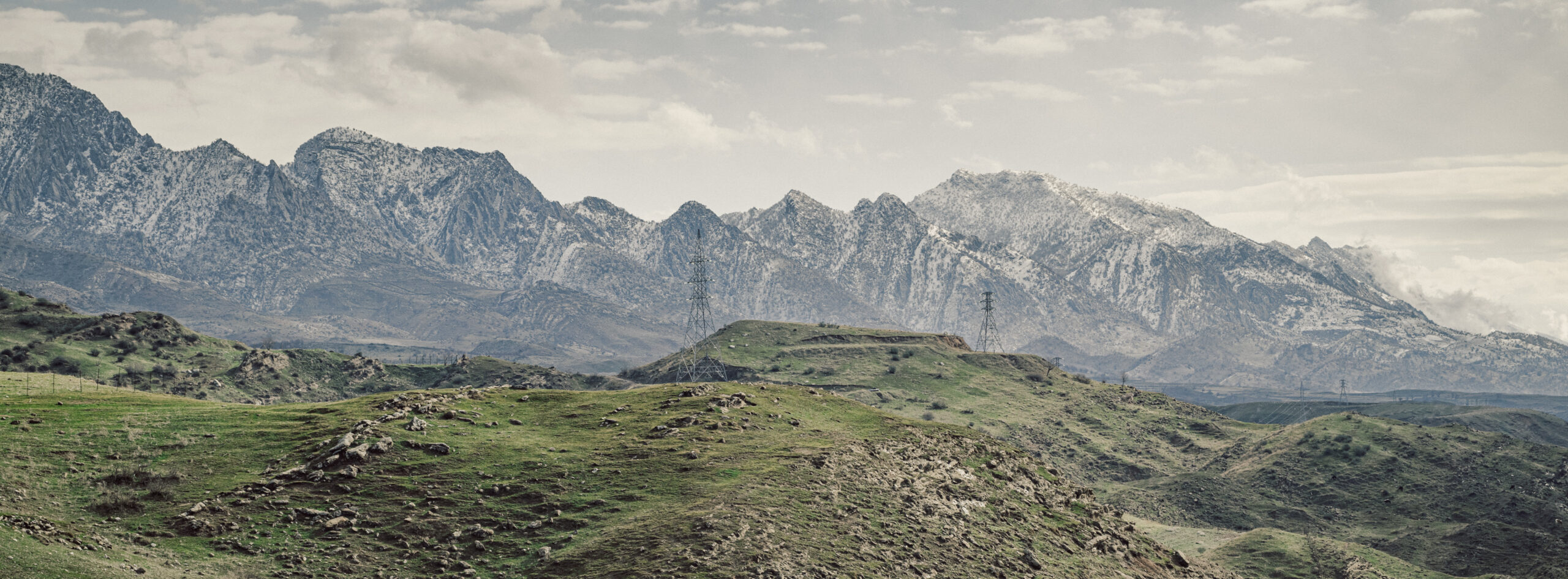
Over the last few years, I have been researching the militarized Kurdish landscape through a triangle of affinities linking the machine, the animal and the human. The interaction between the militaristic, the natural and the cultural unfolds as a sonic battle on the colonized landscape. Sonic booms, bird calls and songs of resistance echo in the same valleys. An ongoing interplay where sounds influence and redefine each other over time. The contents of this essay are part of the sonic landscape of my ongoing research.
Examining the use of flying machines in sonic warfare and propaganda, this essay focuses on a 1932 British military campaign in Kurdistan, occurring during the British mandate in Iraq. Two key historical documents serve as the foundation for this analysis: an article from The Illustrated London News, detailing the use of loudspeakers mounted on a military aircraft to intimidate Kurdish villagers, and a 1930s recording of Deloyloy, a song by the Kurdish Dengbêj (oral poet) Kawîs Axa, commemorating the resistance of Sheikh Mahmoud Barzanji against the British colonial rule.[1]
These two artifacts represent starkly opposed perspectives: one from the imperial machinery of control, and the other from the vernacular traditions of resistance. By looking at them together, I explore how sound functions as both a weapon of domination and as a medium of resilience. How can artistic gestures activate these sonic and visual residues of history?
Voice of the Machine
The digital archive is a strange place. Between paywalls and broken links, it grinds hopes into disappointments. Dust and decay are replaced with compression artefacts and broken pitches. Yet, every now and then pixels shine bright, beats hit right.
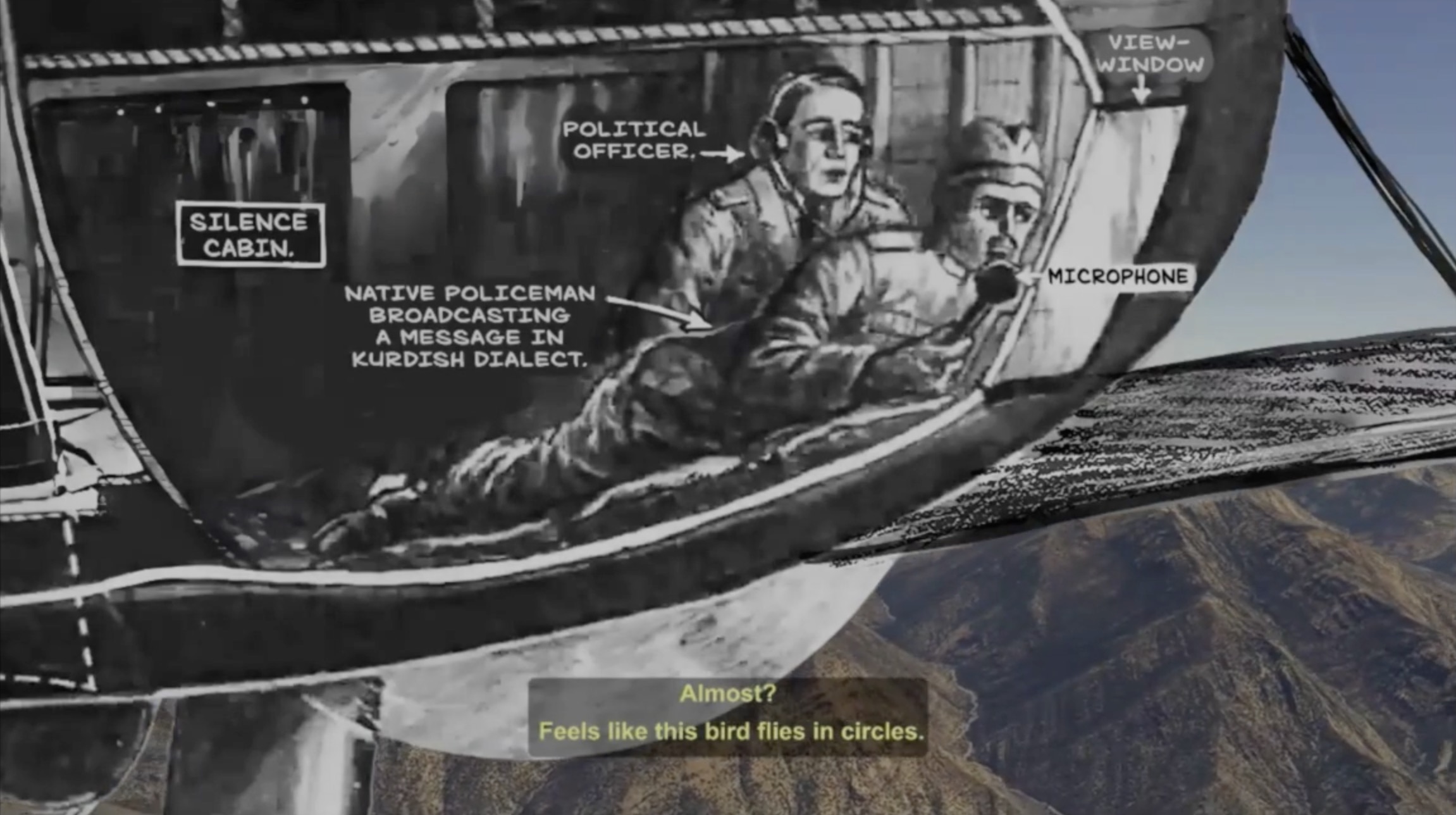
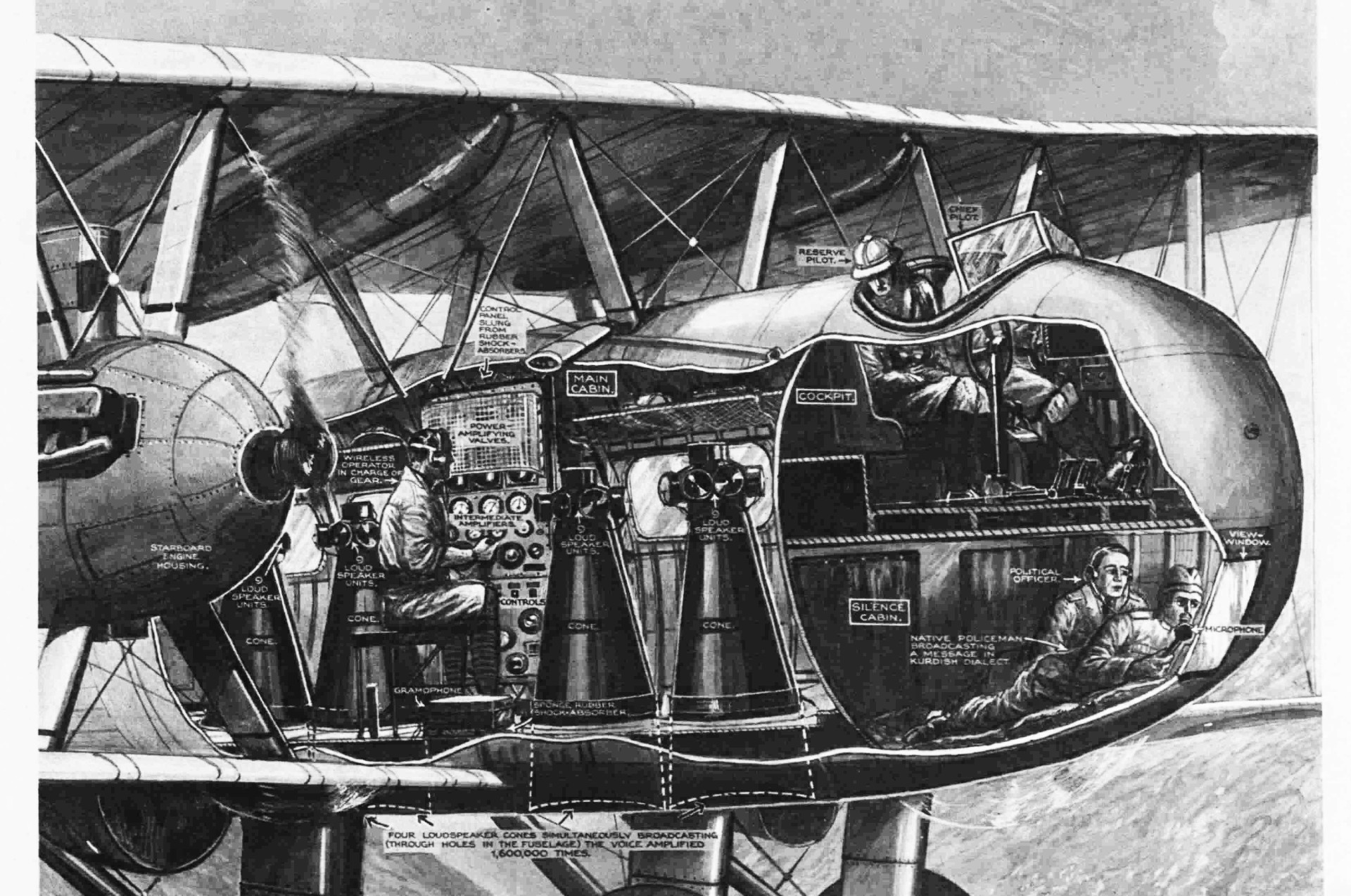
In a doom scroll session of the online archive of the Kurdish Library in Stockholm,[2] looking for historical images of spears and lances, I came across a curious news clipping. It spoke loudly. “AIR WARFARE BY LOUD-SPEAKER: COWING REBELS BY VERBAL ‘BOMBS.’” The image showed a biplane military aircraft fitted with giant loudspeakers flying over Kurdish villages to deliver a loud message: Surrender or die (Fig. 1).
Vickers Victoria – The imperial perspective
Published in The Illustrated London News on April 8th, 1933, this report details the novel psychological war tactics used by British empire. The cutaway drawing reveals the guts of the giant flying machine called Vickers Victoria. This state-of-the-art machine is depicted in utmost detail, with labels for the power amplifier, the control panel, and four loudspeaker cones with nine loudspeaker units in each. The illustration also shows the position of the pilots, the wireless operator, the political officer and a native (Kurdish) policeman who speaks from inside the “Silence Cabin” into a microphone that amplifies his voice 1.600.000 times[3]. The rig is shown gliding above a mountain range and three villages, each labelled “Kurdish Village”. The article gives us the names of these villages as Mawata, Argosh and Banan, located in the Barzan Region of the current Kurdistan Region of Iraq, on the border to Turkey.
The article underneath gives the political context. Accordingly, Sir Philip Sassoon, the British Under-Secretary of State for Air, defended the use of airpower in colonial contexts, in his speech on the estimated costs of the airborne efforts in Kurdistan at the House of Commons during the March 1933 meeting. He argues that it was a more cost-effective method of control compared to ground operations.[4] According to him, a “sky-shouting” method of delivering propaganda in advance of open conflict was successfully used against Sheikh Mahmoud (Barzanji) and Ahmad,[5] and “had a good deal to do with the collapse of this rebellion in North Kurdistan” (The Illustrated London News 1933, p. 503).[6]
In response, Scottish House of Commons member Neil Maclean said that “the use of the Air Force in other parts of the world is justified by a description of the effects which these machines of the air had upon the uncultivated minds of the tribes who were attacked” (Maclean 1933, col. 218). Transcripts of these meetings at the digital archive of House of Commons reveals the perceived effects of psychological warfare of the time.[7]
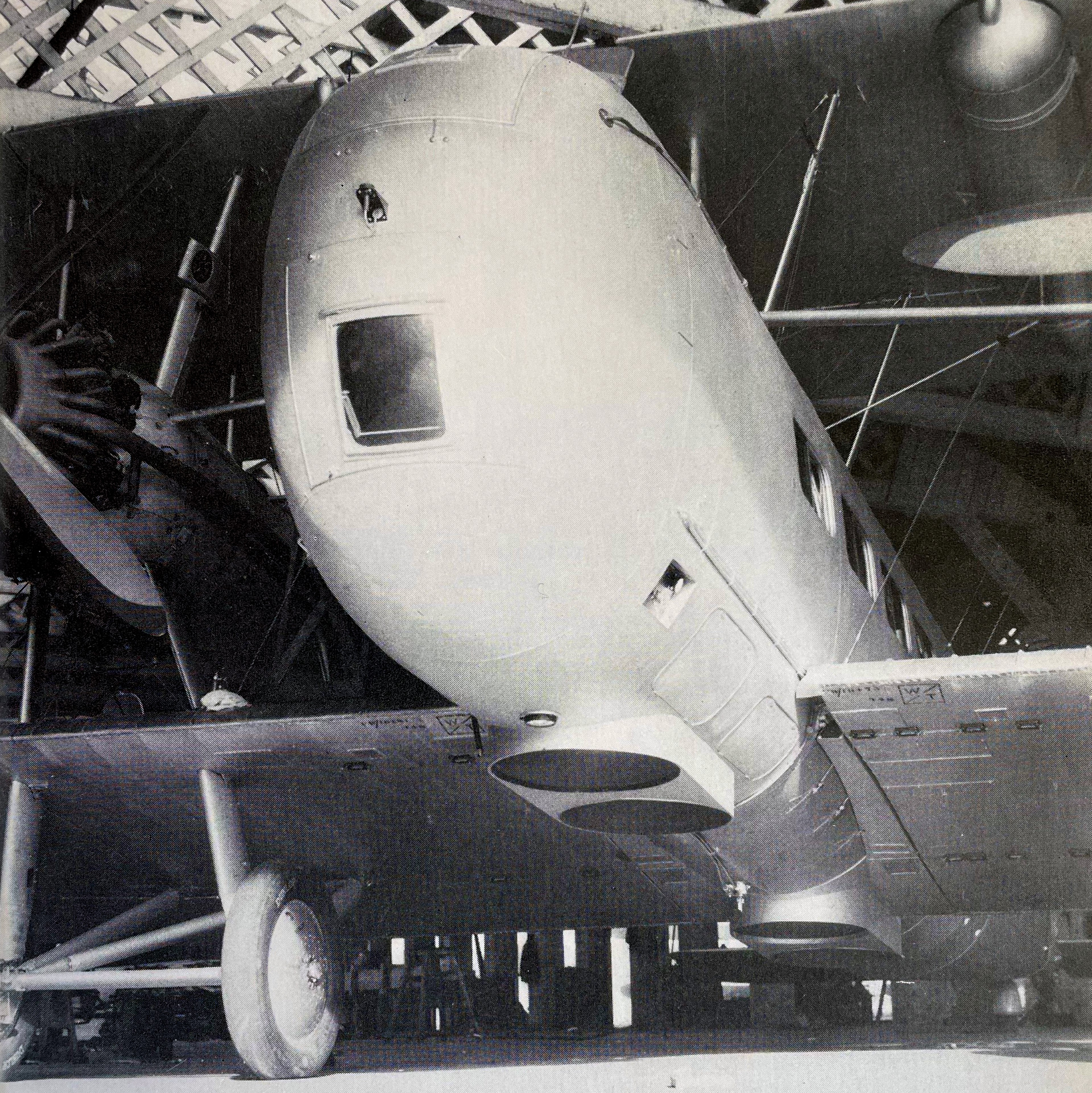
The aircraft used in the RAF (Royal Air Force) campaign, a Vickers Victoria MARK IV, was originally a bomber and transporter, modified with speakers and amplification gear for these purposes in 1932. After the success of the “sky-shouting” modifications, the newer Vickers model ‘Valentina’ were also modified and subsequently deployed in North-West India (modern day North India, Pakistan and partly Afghanistan) and Somaliland (Taylor and Moyes 1968, 141).
Voice from Below: Kawîs Axa
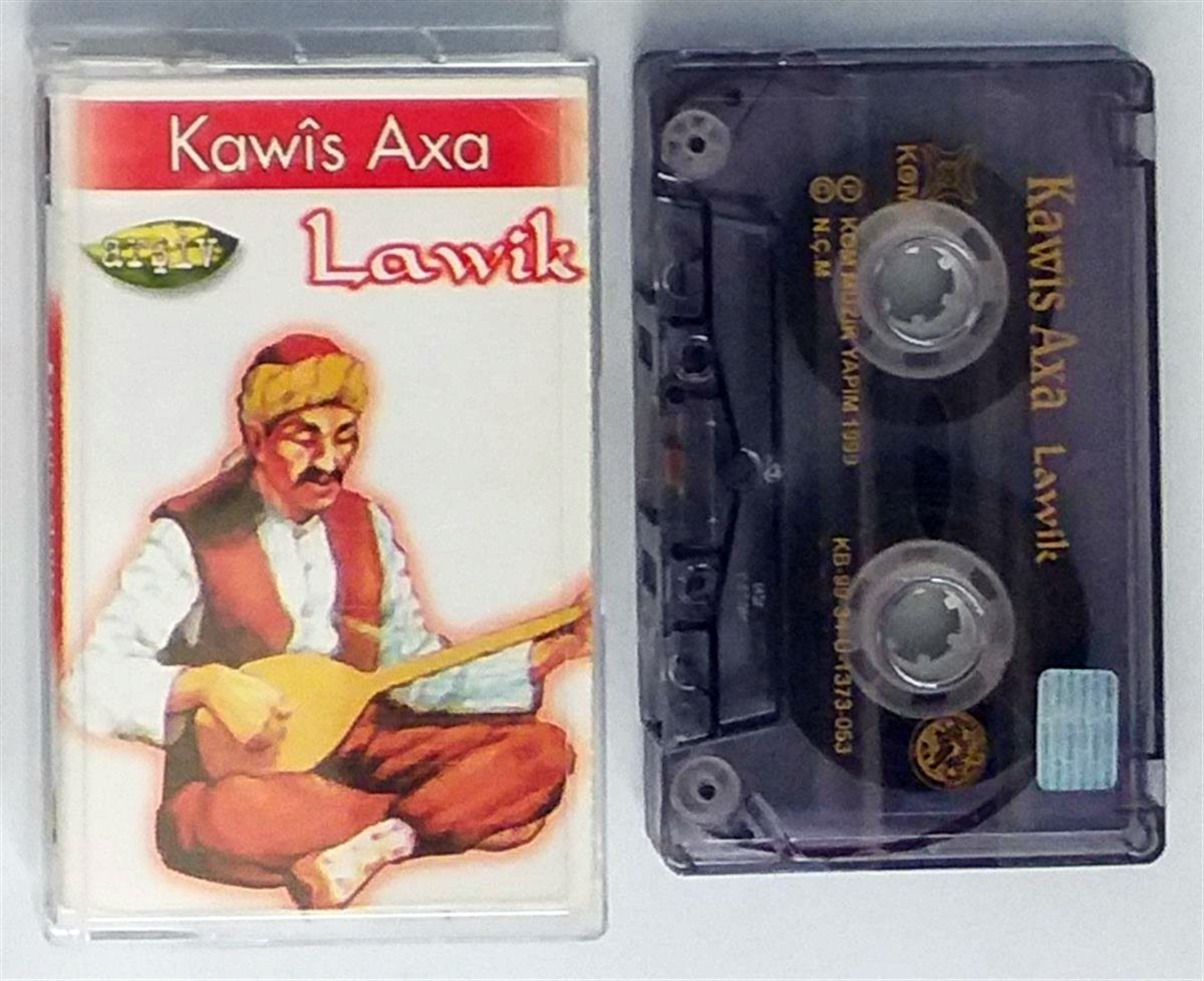
If the loudspeaker-equipped Vickers Victoria represents the imperial perspective from above, “Deloyloy,” a historical Kurdish song believed to have been recorded in the 1930s, provides an auditory counter-shot to the imperial broadcast, documenting the same historical events from the reverse, ground-bound perspective of those who resisted from below.
The Kilam[8] of “Deloyloy”[9] by legendary Kurdish Dengbêj Kawîs Axa, recorded by Baidaphon records in Baghdad in 1930, praises Sheikh Mahmoud’s rebellion against the British Empire, and gives a great deal of historical insight into the political events of 1930s (قويس آغا / Kawîs Axa. 1930). Born in 1889, Kawîs Axa had a stutter when speaking, but was nevertheless a renowned Dengbêj in his time. He met Sheikh Mahmoud Barzanji and Simko Shikakî, two major Kurdish leaders of the period, and composed songs for them.
A Sonic Battle in Language
The Kilam starts setting by the scene with a depiction of a battlefield on Mount Surdash:
“Deloylo deloylo deloylo, Şêxê zirav.
Bihare bi serê Silêmanî yê daketim mihelê şeran û wêla,
li asmana xweş tê girênê teyara, şirqênê metirliyoza,
ringênê bomba, wirşênê tirumbêla
bira gaziye gaziyê nobedara.”
Deloylo deloylo deloylo, oh my slender Sheikh.
It is spring, and I climbed to the heights of Sulaymaniyah, to a battlefield.
The beautiful sky has sounds of airplanes, machine guns,
of bombs and automobiles.
Oh brothers, call the guardsmen.”
Instead of a visual depiction of the places and the events, Kawîs Axa chooses to focus on the soundscape. Skies filled with the sounds of the airplanes, machine guns, bombs, and automobiles signify a sonic invasion. The empire is loud.
Dengbêj Kawîs, listening to the invaded soundscape of Mount Surdash, invents new words for the sounds these machines of war generate. These onomatopoeic expressions (marked in bold) become a verbal imprint of this new soundscape on the poetic and phonetic space of the language. The voice of the Dengbêj, which is shaped in eternal conversations with the cranes, the partridges, the rivers and the winds, enters a new dialogue but this time with the empire and its loud machines of war.
Deloyloy also serves as an historical document, providing a detailed account of the events of the conflict even as it interprets and comments upon them. Names of key the figures of the resistance and names of the places are noted. Details such as how the British flew in reinforcements from India to battle against the Kurds are also described in the song. The main tone of this sonic battle for the Dengbêj is the notion of betrayal. Each stanza of the song closes with the refrain: Oh the Kurds, the traitors… This is an allusion to the internal divisions among Kurdish groups, some of whom collaborated with the British, such as the native policemen in the silence cabin, delivering the message in Kurdish, from inside the modified Victoria Vickers. Taken by the microphone, his voice is amplified 1.600.000 times, and pushed through the speaker cones, raining down as “verbal bombs”.
Yet, who is it that really speaks through the speakers? What is the software that runs the hardware of the war? The message amplified by the giant flying speakers is coming from the empire.
Finale
Both documents, the illustrated article and the song, precisely locate the events they narrate. The article the names the villages, Mawata, Banan and Argoush. The song narrates the battlefield on Mount Surdash. If we turn our faces up and listen, what would we hear in the beautiful skies of these places now? In a recent attempt to visit the villages mentioned in the article, I went to the Barzan Region in Northern Iraq. My intention was to meet the people and listen to the stories and songs of a century old rebellion. I failed. The area is currently under the invasion of Turkish military and all villages are evacuated (compare Shafaq News 2025).
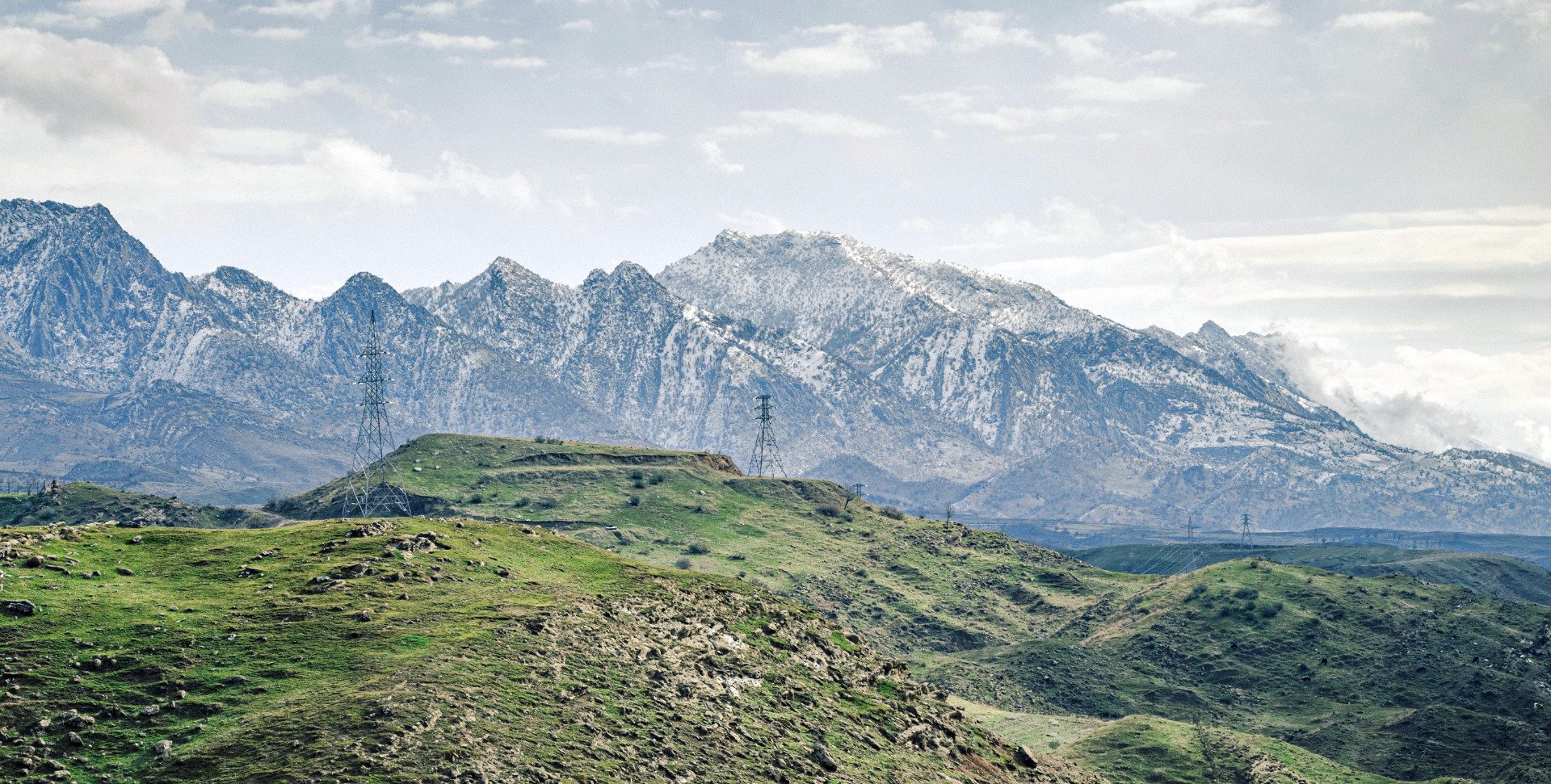
Once controlled by the British Empire, the airspace of the imaginary land Kurdistan is now shared among the air forces of USA, Turkey, Israel, Iran, France and Russia. Conventional, chemical and verbal bombs have been dropping from their machines of the air moving faster than the sound itself. Each machine speaking its own silent language in code, loudly dictates death to the wingless ones. The sonic residues of their explosions linger in the skies.
Afterword
Let’s remember the microphone in the silence cabin of Victoria Vickers and whisper these questions to it: Could this same microphone delivering the verbal bombs, be used by Kawîs Axa to record the songs of the rebellion? Can the machine take sides, can it be forced to betray itself? And in the contemporary landscape of militarized skies, can the song speak louder and for longer than the machine?
[1] Dengbêj is a compound of ‘deng’ (voice/sound) and ‘bêj’ (to tell).
[2] Part of the Kurdish Exile Museum, Stockholm, see also https://www.saradistribution.com/commontable.htm
[3] How this amplification amount is calculated is not explained in the article or in the drawing. As is, it remains as an unverfiable number. Thanks Johannes Maria Schimdt for his comment.
[4] Birds of Death, an episode of Channel 4 documentary series Secret History, provides more information on the RAF (Royal Air Force) campains in Kurdistan and Waziristan (London 1992).
[5] Sir Philip Sassoon’s report referred to events of the previous year. According to RAF records, the actual event of using the aircraft with the speakers took place on 25th of April in 1932 (Royal Air Force Museum, n.d.).
[6] North Kurdistan in the 1933 article refers to the northern part of the Iraqi Kurdish territories, on the border to Turkey. Not to be confused with the contemporary use of the phrase referring to Turkish Kurdistan.
[7] The publication of this article in a newspaper for readers in London adds an additional layer in the psychological warfare conducted by the Empire. As the news of RAF bombings and the use of chemicals against civilians in Kurdistan began to circulate in 1920’s, RAF reports from the region were being censored by the Chief of the Air Staff (London 1992). Promoting novel psychological warfare techniques as an effective method through the citizen-facing press can be seen as an effort to shape public opinion in the heart of the Empire – another attempt at amplified/mediated psychological manipulation but this time internally directed.
[8] Kilam, is an epic acapella song/poem, sung history. The word Kilam, originates from Arabic word kalām كلام, meaning ‘speech’. An alternative etymology of the word leads to the sound of the bubbling water in natural springs.
[9] The recording Deloyloy appears with different titles, such as, ‘Şêx Mahmûd’, ‘Şêxê Zirav’, ‘Delêl’, ‘Deloyloy’. Although there are some speed and pitch differences, all these titles refer to the one and same recording.